
Emergency Roof Repair Near Me: What Victorville Homeowners Should Do First
If water is actively coming through your ceiling in Victorville, your first two moves are not “call a roofer.” They are contain the water and document the damage. Only after those steps do you call a roofing contractor, and the order matters because it directly affects whether your insurance claim gets approved and how much interior damage you’re left holding. If you’d rather skip the DIY containment and go straight to a professional, call (866) 942-0875 and we’ll walk you through it.
We’ve been called out to homes across Victorville after storms have torn off shingles, after tree limbs have punched through decking, and after homeowners discovered a slow leak had turned their attic into a sponge. The homes that fare best are always the ones where the homeowner followed a sequence. The homes that fare worst, the ones with mold by the time we arrive, are almost always the ones where someone’s first instinct was to call around for quotes while water kept running through the ceiling.
This guide is that sequence, written for Victorville specifically because our wind patterns, our summer monsoon bursts, and our older housing stock create a particular set of roof emergencies that a generic national article won’t cover.
Step One: Contain the Water Before You Touch Your Phone
The most consequential thirty minutes in any roof emergency happen before a contractor ever arrives. Water follows gravity, and gravity doesn’t wait for you to compare reviews. Every gallon you stop from reaching your drywall, your insulation, and your electrical fixtures is a gallon you won’t pay to remediate later.
Here’s the exact containment sequence we teach Victorville homeowners:
- Move or cover anything you actually care about, but photograph it first. This sounds backward, but your insurance adjuster needs to see what got damaged and where it was sitting. If you haul a soaked sofa to the garage before taking photos, you’ve erased evidence the adjuster would have used to confirm your claim.
- Place a bucket or large container directly under the active drip. This is obvious, but we’ll say it anyway because in a panicked moment, people forget: make sure the container is stable and won’t tip when it’s half full.
- Punch a small hole in the ceiling if water is pooling and the drywall is sagging. A sagging drywall bubble holds gallons of water. When it bursts on its own, it takes insulation with it and floods everything below. A controlled hole, placed over your bucket, releases the water where you want it. This is the single most important damage control move and the one homeowners most often miss.
- Kill power to any affected circuits if water is anywhere near a light fixture, ceiling fan, or outlet. Water and electricity don’t mix, and a wet fixture is a genuine safety hazard. If you can’t safely reach your breaker panel without standing in water, leave it alone and tell the electrician or roofer when they arrive.
- Throw down towels, drop cloths, or old blankets to protect flooring. Water that pools on hardwood or laminate is a much bigger problem than water that hits a towel first.
One thing we see over and over in older Victorville neighborhoods, places like the homes off 7th Street or up near the fairgrounds, is that decades-old drywall absorbs water faster than newer builds. If your home was built before the 1980s, don’t wait to see if the dripping stops. Contain first, assess later.
Step Two: Document Everything in the Order Insurers Require
Your insurance claim lives or dies on documentation. Here’s the photography and note-taking sequence that consistently gets Victorville homeowners the cleanest claims, and it’s the same sequence our team follows when we document damage during a roof inspection.
Shoot wide first, then tight. Your first photo should capture the entire room so the adjuster can see the leak’s context. Then move closer. Get the ceiling stain, the pooling water, the dripping point, and any damaged belongings. The wide shot proves the leak is real. The tight shots prove the extent.
Photograph the ceiling, then the attic, then the roof deck. If you have attic access and it’s safe to poke your head up (don’t walk on joists if you’re unsure), photograph the underside of the roof deck where the water is coming through. That photo is often the most valuable piece of evidence because it shows the actual point of entry, not just the symptom.
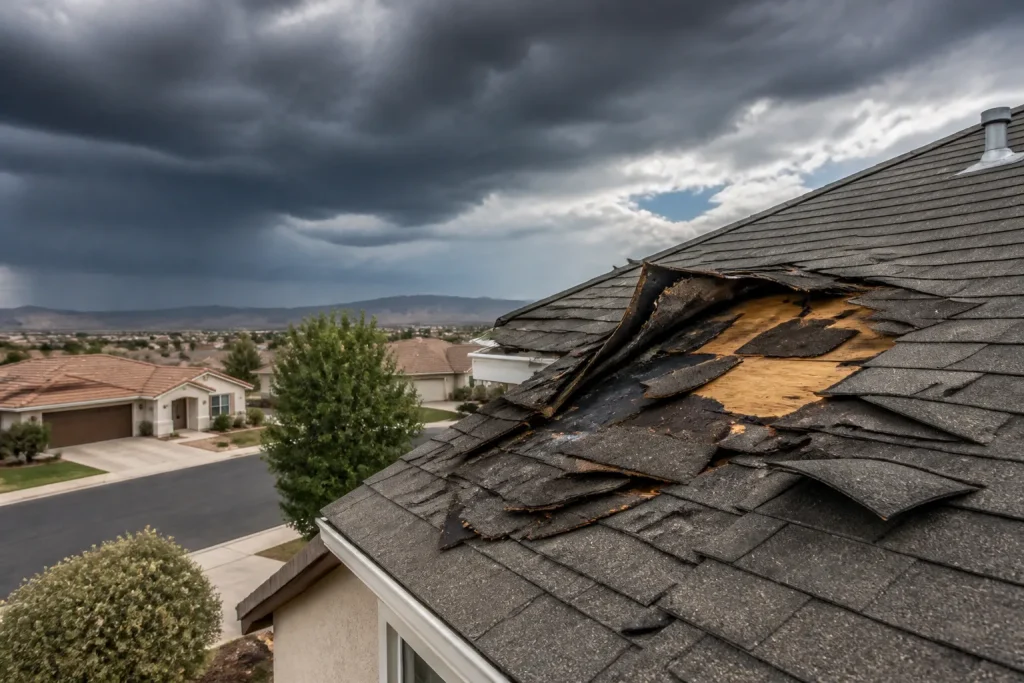
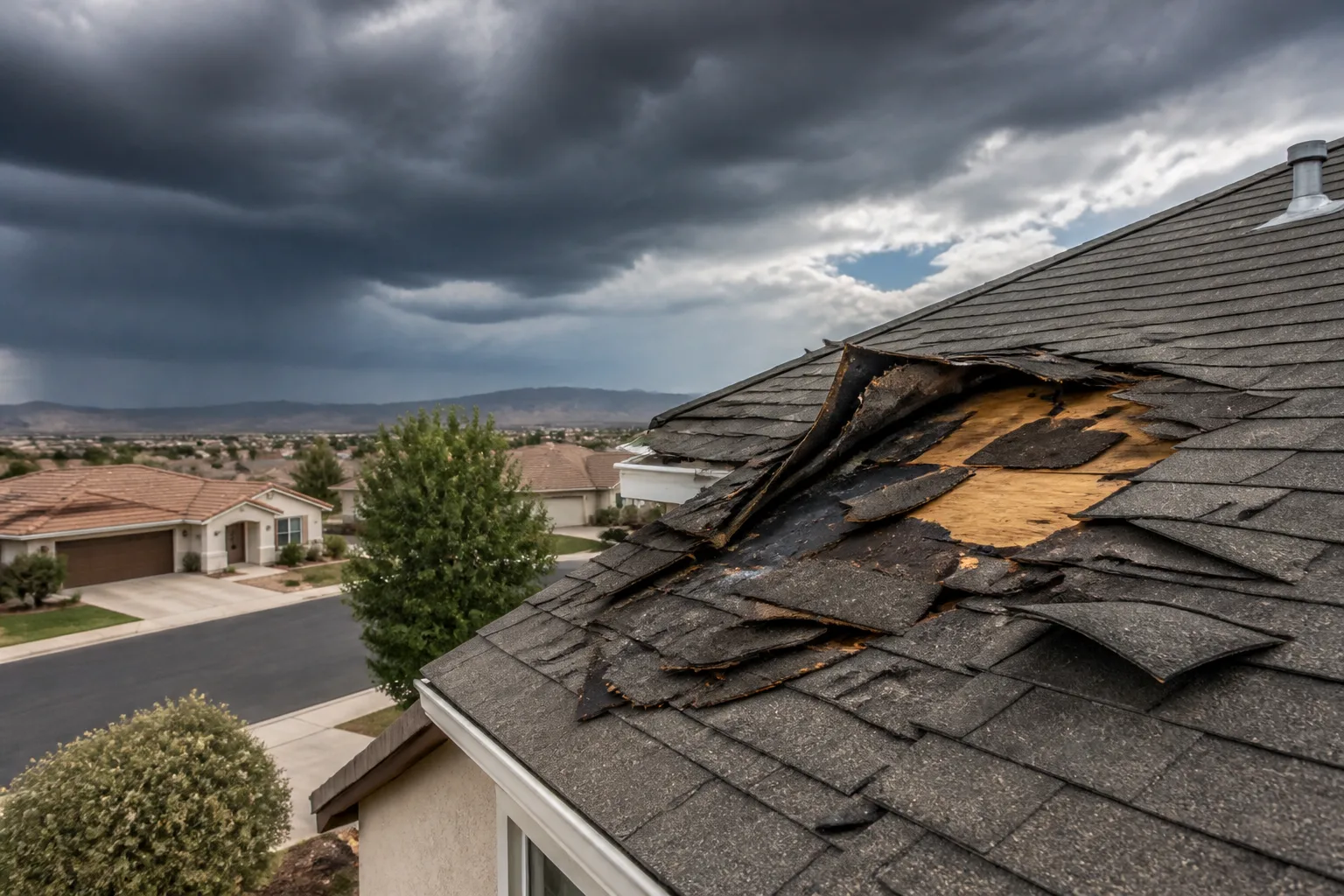
Document the exterior from the ground. In Victorville, where high winds during spring and late summer storms are common, what you’re looking for from the ground is missing shingles, lifted edges, or debris that’s clearly been thrown against the roof. A photo of a tree branch lying across your roof tells the adjuster the story before you open your mouth.
Write down the date, time, and what you observed. A simple note in your phone works. “Thursday 4:15pm, noticed water dripping from hallway ceiling, wind storm overnight, found shingle pieces in yard.” That timestamped note anchors your timeline.
What you should not do is move damaged items out of the room before photographing them. We understand the instinct to clean. But every time a Victorville homeowner has told us “we cleaned it up before we thought to take pictures,” the insurance conversation got harder. Document first, clean second.
Step Three: Assess the Exterior Safely, From the Ground
We’ll say this clearly because it matters: do not get on your roof during or after an emergency. The two most dangerous things a homeowner can do in a roof emergency are walking on a wet, damaged roof and climbing a ladder in the wind. Both send people to the ER every year in the High Desert, and neither tells you anything a ground-level assessment can’t.
What you can see from the ground in Victorville, especially in the flat light of early morning or late afternoon, is often enough to give your roofer a useful head start:
- Missing shingles show up as darker patches against the granular surface of the remaining shingles.
- Lifted or flapping shingle edges catch the sun differently when they’re curled upward.
- Debris accumulation, especially from the cottonwoods and junipers that are common around Victorville properties, often concentrates at roof valleys and eaves, and those are exactly the spots where water pools and backs up under shingles.
- Granule loss shows up in gutters and at downspout outlets as a grainy black or gray sludge. If you see it, your shingles are losing their protective surface, which accelerates leaks.
- Tile displacement on older homes in Victorville’s older sections, where clay and concrete tile roofs are common, broken or slid tiles are visible as gaps in the roofline.
If you see a branch punch through the decking, or daylight visible through the roof from inside the attic, the damage is beyond what a tarp will handle. That’s a structural emergency, and it’s time to make the call. For everything else, the question is whether temporary weatherproofing will hold until a proper repair can be scheduled.
Call Roof Repair in Victorville if you’re not sure what you’re looking at. We’d rather spend ten minutes on the phone helping you assess than have you guess wrong.
Step Four: Temporary Coverings That Help Versus Ones That Hurt Your Claim
There’s a right way and a wrong way to tarp a roof in Victorville, and the wrong way can void a manufacturer’s warranty or complicate your insurance documentation.
What works: A properly secured tarp is a legitimate, recognized temporary measure. If you’re going to tarp, use a heavy-duty poly tarp (not a painter’s drop cloth), run it over the ridge to the opposite slope so water can’t get under the leading edge, and secure it with furring strips screwed through the tarp into the decking. Never nail into shingles you’re hoping to save. This is honestly best left to a roofer because a tarp that blows off in a Victorville windstorm at 2am is worse than no tarp at all.
What hurts: Spray-on sealants, roofing cement applied as a large patch, or any “emergency” product that leaves a residue on the shingles. These often void manufacturer warranties because they prevent proper bonding of the replacement shingles. They also make the actual roof repair more expensive, because the technician has to clean or replace contaminated materials before installing new shingles properly.
What to say to your insurer: Tell them you have an active leak and you’re taking steps to mitigate interior damage. Use the word “mitigate.” Don’t say “I’m going to fix it myself” or “a friend is going to patch it.” Say “I’m documenting the damage and I’ve called a licensed roofing contractor to assess.” That language keeps the claim clean and signals that you’re doing what a reasonable homeowner would do to prevent further loss, which is exactly what the policy expects.
In Victorville, where summer monsoon season can bring a downpour with almost no warning, the gap between “tarp it” and “repair it” can be measured in hours. If you’re even slightly unsure about weatherproofing, call (866) 942-0875 and we’ll assess whether a tarp is the right call or whether we need to schedule an emergency repair immediately.
How to Vet an Emergency Roofer in Under Two Minutes
Roof emergencies attract storm chasers. It’s an ugly reality of the industry, and Victorville gets flagged on their radar whenever a big wind storm rolls through the High Desert. They show up fast, offer cheap tarps, take deposits, and disappear. By the time you realize the work wasn’t done or the tarp failed, they’re two counties away.
Here are the three questions that separate a legitimate Victorville roofing contractor from a storm chaser, and you can ask all three in a two-minute phone call:
- “Are you licensed to work in California, and will you show me your license number on your vehicle and on your paperwork?” Legitimate roofers put their license number on everything. It’s a point of pride. If the answer is vague or defensive, hang up.
- “What’s your local Victorville address?” Not a P.O. box, not a cell phone number with no address, not “we’re from out of town helping with storm recovery.” A real address in or near the Victor Valley means they have a stake in their reputation here. When the tarp fails and you call them back, you want someone who answers.
- “Will you give me a written, line-item estimate for the permanent repair before any temporary work starts?” A legitimate roofer wants you to know what the full repair will cost. A storm chaser wants to tarp quickly, take a deposit, and avoid the written estimate because it creates a paper trail.
We also tell Victorville homeowners to ask about manufacturer relationships. A contractor who carries multiple brand lines, the way Oakmont does with GAF, CertainTeed, Owens Corning, and IKO, is a contractor who’s accountable to manufacturers, not just to you. Manufacturers only certify and train installers who meet their standards, and they’ll pull that credential fast if the work is sloppy. That’s an extra layer of accountability a storm chaser will never have.
If you’re already on the page and thinking about the long term, Roof Inspection in Victorville is the smart starting point before committing to any repair or replacement spend.
What to Tell the Insurance Company in the First Call
Your first phone call to your insurance company matters, and the specific words you use affect how the claim is processed. This is especially true in Victorville, where wind damage claims can get tangled up with questions about whether the damage was “storm-related” or “pre-existing.”
Here’s the sequence we recommend, and this comes from years of helping Victorville homeowners navigate the aftermath of High Desert storms:
Say exactly when you noticed the damage. “I noticed water coming through the ceiling at 4:15pm today.” A specific time anchors the event.
State the probable cause without speculating too hard. “We had heavy wind overnight and I found shingle pieces in the yard this morning.” You’re stating facts, not reaching conclusions. Let the adjuster connect the dots.
Describe what you’ve done so far. “I’ve contained the water, documented the damage with photos, and I’m calling a licensed roofing contractor to assess.” This is the language of a responsible homeowner, and it sets the tone for the whole claim.
Ask for the claim number and the adjuster’s contact information. Write both down. You’ll need them when the contractor’s estimate references the claim.
Don’t agree to any repair scope or dollar amount on the first call. The adjuster hasn’t seen the roof yet. Neither have you, in any detail. Anything you agree to over the phone limits your options later. The correct answer to “do you know what this will cost?” is “I’m getting a professional assessment from a licensed roofer and I’ll send that to you.”
If you’re using a roofing contractor who carries multiple brands, like our work with GAF and CertainTeed, your adjuster will see a material line item that’s verifiable and current. That’s the difference between a claim that gets approved at fair value and one that gets picked apart over generic “roofing materials” placeholders.
The Bottom Line
When water is coming through your ceiling in Victorville, the sequence is simple: contain, document, assess from the ground, call a licensed roofer, and speak to your insurer with clear, factual language. Every step protects your home and your claim. Every skipped step costs you money.
If you’re dealing with an active leak, storm damage, or a roof that just gave way, Oakmont Roof Repair offers free estimates and we’re familiar with Victorville’s housing stock, its wind patterns, and its insurance landscape. We carry seven major brand lines, including GAF, CertainTeed, Owens Corning, and IKO, so the material recommendation you get is based on what your roof actually needs, not what we happen to stock. Call Oakmont Roof Repair home at (866) 942-0875 for a free estimate. If a full replacement is on the table, Roof Replacement in Victorville is our next-level service, and we’ll walk you through whether repair or replacement is the right call for your roof.
Frequently Asked Questions
Move or cover valuables after photographing them, place a container under the drip, punch a small controlled hole in sagging drywall to release pooled water, and cut power to any affected circuits. Then document everything with photos before calling a roofer.
You can, but a poorly secured tarp that blows off in a High Desert windstorm leaves your roof exposed worse than before. If you’re tarping, use a heavy-duty tarp, run it over the ridge, and secure it with furring strips screwed into the decking. If that’s beyond your comfort level, call (866) 942-0875 and we’ll handle it correctly.
Active water intrusion is always an emergency. Missing shingles with no active leak can usually wait a few days, but get them assessed quickly because Victorville’s wind can turn a small gap into a big one fast. If daylight is visible through the roof deck from inside the attic, that’s a structural emergency, not a scheduling question.
Most homeowner policies cover sudden, accidental damage from storms, falling trees, or other covered events. They generally don’t cover wear and tear or long-term neglect. Document the damage before cleaning up, be specific about when you noticed it, and use the word “mitigate” when describing your response. For an exact quote on repair costs in Victorville, call (866) 942-0875 and we’ll give you a written, line-item estimate.
Written by the team at Oakmont Roof Repair, serving Victorville since 2013.
Need Roofing Help?
Call Oakmont Roof Repair — licensed & insured, here with fast after-hours help in Wrightwood.
(866) 942-0875